Heavy rain greets
us in the morning. We’ll wait for it to abate before leaving in the boat.
You can determine
the size of the country by the number of digits in the phone number.
The boat ride to
Puerto could have gone really badly, but our boatman, Keraton, is a genius at
reading the waves. We bob up and down for a good fifteen minutes just beyond
the Armila beach and then he sees a break and guns the motor. But we don’t slap
hard down after the crest, because he throttles back, playing the two 40HP
engines like a pair of musical instruments.
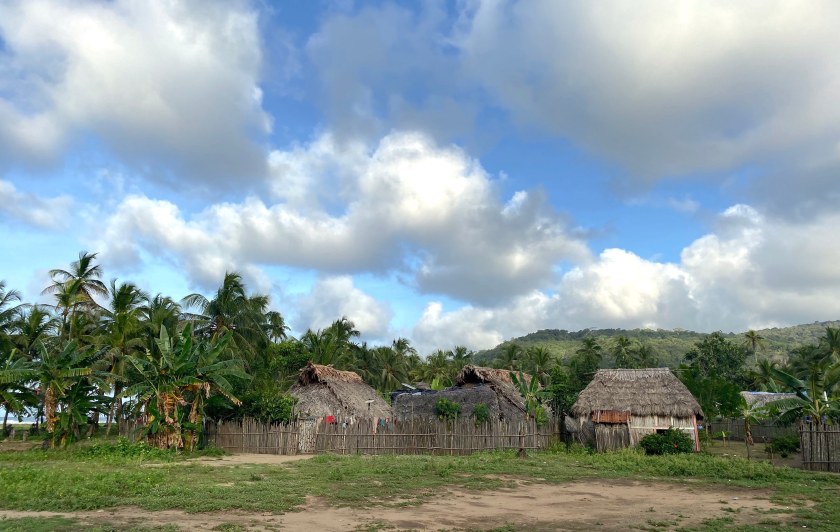
We have some time in Puerto Obaldia so we grab a drink at the bar and walk to a bakery for a snack. Puerto feels rundown and makeshift. It is not a place where one can find beauty. It’s a patchwork assortment of houses and shops and has none of the charm of the Guna communities. The people here are darker-skinned, heavyset and pretty surly. Many originate from Columbia and some are actually descendants of the workers from the banana plantation in Anachucuna. Puerto is on Guna land, but the Guna were not able to take it back.
Today is about
tying up loose knots, small mysteries. Bernie never got her missing power bank
back and we wondered why, when the thief has been caught. It turned out that
the boy was ordered by the sahila to be sent elsewhere to be tried under
Panamian law rather than Guna law, but he hid himself, or was hidden by his
family, so he could not be found.
And why there was
so much opposition to the drone was simply because drug smugglers use drones to
map out routes to run their boats, so people in Anachucuna and I guess
everywhere else are very afraid about the police seeing a drone and assuming it
belongs to a smuggler. And perhaps that’s why I never received permission in
Armila to fly either.
Charlotte had a
dream on the first night of the chicha. Earth was a cube with water lapping on
all sides. We stood on the shore and the ocean grabbed Charlotte’s flip-flop,
she lunged for it but the ocean pulled her in. We grabbed onto her, one by one,
a long line, and then we began to travel through the ocean and the eight layers
of the earth, something derived from Guna mythology.
The day is the
muggiest we’ve had. Everything is wet and sticky but the process to leave is
smooth and the plane arrives ahead of schedule.
*
On one of our
visits to Lucia, the animal communicator, earlier this year, Chubs told me that
I would meet people during my residency that would help me with the memoir I am
working on about growing up as an Evangelical Protestant. And he was absolutely
right. Though Chubs passed a month ago, I still feel that he continues to teach
me through the Guna community and the artists with whom I’ve had the pleasure
to talk, work and walk with over the past three weeks. It’s not so much about
the content, because all of that comes from me and is already something I have,
but a new way of seeing and being.
A way to live in a
plastic world and yet not lose sight of the real world that I have found these
few precious weeks here in Armila.
October 17 – November 7 2019 Armila, Guna Yala, Panama
The mosquito net
has been successful in keeping out many other things other than mosquitos,
including the house rats that regularly have a dance party on our roof beams.
The jagua is a bit
smudged but largely intact. Then I notice I’ve somehow printed the inside of my
palm with half a frog print. It’s… kinda cool. Could have been worse. I could
have printed my face! Caroline quips, ‘A frog on the palm is worth two on the
arm.’
She says that her
husband once finished the proverb, “A bird in the hand… why are you holding a
bird in your hand? It’s disgusting. Get rid of it!” Which makes me think of
real-world use of proverbs in urban settings. It’s hard enough to catch a damned
chicken!
The shape of the
beach has changed because of the storm. There used to be a wide sandy area
where a volleyball net was set up. That has been completely eradicated. And
further down, the ocean has swallowed so much sand it has come right up to the
creeping vines. Must be nice to have your beach remodeled every few months or
so.
My mola shirt is
ready! The pattern on the collar and the cuffs is really beautiful. It’s a
little too fitted on the sides, so Aida is going to take it out a bit. But the
length is perfect.
Maria is being
fitted today with a pair of leg uinnis. It’s a painstaking process to fit the
beads one by one onto a string and then to make sure the patterns align as the
rows build up. They had to take measurements of her leg, because the
circumference isn’t constant. Usually, the uinnis are worn for a month at a
time. Is this cultural appropriation or honouring culture? It isn’t something
bought at a tourist outlet and is made with the full permission of the sahilas.
In fact, it generates income and also becomes a talking point about the Guna
and their way of life. It’s a bit of a moral conundrum though, as it’s
something not for her and yet customised just for her.
Someone in the
village has a ñeque, and we head over to see it. It’s caged up but seems happy
enough to nibble on the papaya strips and potatoes we have brought. This was
the beautiful mouse we have been meaning to visit, although at first glance it
seems more like a lanky desert rat. It has legs for days, long claws and an
elongated snout. Fascinating!
A line from
Bachelard quoting Pierre-Jean Jouve, “Poetry is a soul inaugurating a form.”
Bachelard explains, “The soul inaugurates. Here it is the supreme power. It is
human dignity. Even if the “form” was already well-known, previously
discovered, carved from “commonplaces,” before the interior poetic light was
turned upon it, it was a mere object for the mind. But the soul comes and
inaugurates the form, dwells in it, takes pleasure in it.”
After this residency, we will all head into certain uncertainties. I return with natural gifts for friends; seeds, pieces of wood, shells, small rocks. Reminders to me that friendships are organic, living things and that a gift can also be an everyday object shaped by the imagination into something uncommon. Something akin to the life of an image.
The water is
coming back on. Very slowly. So we fill up the large container because it may
not stay on forever.
Everyone decides
to go for a swim in the river simply because the day is too beautiful to
ignore. The water is cold and rejuvenating and I swim to the other side, the
one that has two shores, on one side the river and the other, the ocean.
The river shore
deposits seeds and long palm fronds and driftwood. The ocean brings plastic,
though this afternoon, it is trackless, the sand unbroken. I finally find a
maracas seed. It gets wet on the swim back, but hopefully it will dry out.
Packing is hard
when you’re still finding things on the beach, but I think that I shall give
some of them away as gifts.
Everyone does a
quick interview with Luz and Luis about their time here. It’s for the La Wayaka
archives but it’s also a chance for me to articulate what I’ve been doing here.
It’s brilliant
weather, so I go for a walk and capture the light down Coconut Way. There’s
hasn’t been light like this most days during the golden hour, so today has been
a blessing. As soon as I get back, Charlotte is looking for a buddy to go
walking with. Everyone is still packing, so off I go again. She tells me about
the La Wayaka residency in the Atacama Desert of Chile, which she just
finished, and it sounds like an absolutely transcendental experience. On
another note, I am really going to miss aligning my days to the natural rhythms
of the light.
Luz calls us out
to see the evening sky. Venus, Mars and Saturn are aligned, just like on
Zlatan’s mobile. It’s incredibly
significant to see this but interpretation is a complicated beast and it means
different things to different people.
I write a poem for
everyone. Seven poems in an evening is tough, but I’m glad everyone likes their
poems.
The differences
between the village and the city are never more stark than here in Armila.
Here, the community is close-knit. Everyone knows your name, your family
history and all your flaws and glories. But everyone also takes care of each
other. Community anywhere is beautiful. Community connected to the land is
nurturing.
There is so much
value to Nachito growing up here instead of the city. According to Nacho,
villagers who have worked in the city said that they were miserable and didn’t
have any friends. Cities are designed for isolation; for maximum productivity
and minimum happiness.
We never got to sit in on a Congress meeting, but apparently there was some drama tonight. The foreman who has been in charge of the crew building what is to be the biggest house in the village was hauled up before the congress for being, well, a horndog. Apparently, he had been doing the deed with a few women around the village and the sahilas frown upon such loose behaviour. It’s not so much about being married but about being faithful. He had been previously warned and fined for this. And now he did it again, with the same woman that he was caught with before. The poor woman was shamed because she was exposed. The man was going to be fined again and expelled from the community, as he isn’t from Armila. But before that judgment was made, the woman was asked if she loved the man and wanted to marry him. And she said yes. The sahilas asked the man the same question. And he said no. That sent everyone into a tizzy.
4am. A series of strobe lights flashing into my room wake me up. There is a massive roar and a series of explosions. I wake up groggy, thinking that FARC guerillas have invaded us. But, pulling off my earplugs, I hear the lashing sound of rain. I walk out of my room and am awestruck by the most ferocious storm I have ever seen. The lightning seems to be right above us and the thunder rumbles all around. The ground shakes, the frame of the house trembles. Because the lighting is so frequent, the thunder is a continuous sound. I am transfixed. I do hope that lightning doesn’t strike any of the houses. The storm carries on at an incredible intensity for three hours.
At breakfast Maria
says that she had a waking dream where her wood spirit made her swallow
something. He was all eyes and had a small face.
The river is a
rage this morning. Driftwood practically sprints down. They could also be
crocodiles looking for a quick eat-and-run. We are out of flushing water in the
house and have to draw buckets from the river.
There isn’t one
particular rainy season here. It cycles between periods of dry and wet.
Bernie is running
a pattern-cutting workshop this morning for the women of the local Guna
cooperative. It would be good for them to design their own clothes other than
just traditional wear.
The heartwood is
pointed because it was used to hunt, as a weapon.
One of the boats
nearly floats away. A few men have to wrestle it back from the grasping
current.
Now I get why
people were tying their boats up at the house last night. They knew something
massive this way comes.
Luis and I manage
to tidy up our four songs and record them. Luis and Veronica help me to translate
five of my poems to Spanish. I’ll display them later along with my objects.
Jagua is out of
stock everywhere. Brigida, who runs the women’s cooperative, has one more seed
that she is hoarding. She offers to paint a line on everyone’s face. Nobody
takes up the option. Would that be an instance of appropriation? Ignorance and
innocence.
The chicha house still smells of chicha.
If the sea is too
rough on Thursday, we will load the luggage in the boat and walk to Puerto
Obaldía, which should take just over an hour, but the weather seems to even out
into a mild day. My clothes smell of river and sand. There is still no running
water and the river is brown with churned up silt.
At three, we
scramble to get the open studio ready for a select group of visitors.
The schoolteachers, the sahilas and a couple of women who are community leaders attend. We speak in English, Luis translates to Spanish and Nacho translates to Guna.
I open with a spoken word piece that Luis has beautifully set to music.
The Arms of Armila

The beach of Armila is a woman with open arms. We sing to her, praise her curves, swoon at her shore. There are treasures in her body, the pleasures of the sea. We sit at her feet and contemplate the lifted brow of sky, the ocean humming miles of roar and murmur.

She lifts her voice and we hear her call. We wear the geometry of her seasons, live under the bounty of her thatched roof.

Armila,
we dance to you, to the rhythms of your tide; we dance until the night recedes and the frogs have stopped calling and we see glimpses of that tree of old, the one that fell and out spilled the world, and from that seed came all your beauty.

The ocean is a patient grandmother bringing gifts for her daughter.
And you, Armila, you take it all in
Driftwood and bursting diapers
Coconut husks, fallen feathers
Bottles of rum, fragments of shells
FM radios, bicycle bells
Seeds that rattle, broken turtle eggs and styrofoam like bits of a fallen sky

Armila,
may you not weary of the plastic bottles that line the hem of your dress. They hold the colour of the clouds when you walk. May you lay abandoned deck chairs on the shore so you can drink in all of the sunset. May coconuts open their tenderness to you. May children lose and find themselves each evening in the golden hour. May you always turn your face to the light.

Armila,
I will sweep the sand between your toes forever.
I then explain the poems I have been working on, two sets of twelve poems. One, Plastic Ghosts, is about plastic objects from the beach while the other is a response to 12 small installations from found objects. I show the one plastic object I have saved, a dice, and six of my installations. An insight, among many, that I have gleaned from this residence is that there is no art without community and no community without art.
Berenike presents
instant photos and a journal with leaf pressings and various clothing designs
for women to work on such as hats and kimonos! She has an eye towards line and
color, simple yet striking.
Caroline says that
life in the US is like the Armila river – fast! and it has been great to be
able to slow down to observe and represent visually what she has seen.
Caroline’s colour palette is amazing, delicate yet full of detail. She’s
working on an illustrated journal, and concludes by saying that the world is
really lucky that the Guna have preserved their land, their culture and their
spirit, because they have so much to share.
Verónica’s piece
de resistance, still in progress, is a gorgeous carving on a tortuma of the
twelve months of the year with Guna names and symbols in it. Her work is
detailed and delicate, tinged with a natural inclination to form, function and
beauty.
Maria made a
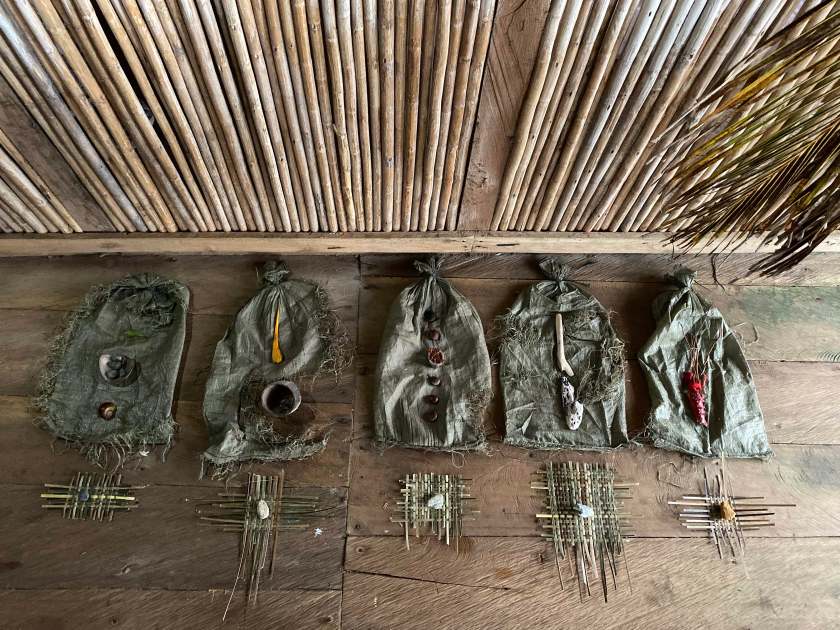
traveling altar; her practice is based on meditation. The pelican bones she
found features in it.
Charlotte has a
wide selection of drawings and installations. She is interested in how things
affect each other and the collision between animal, vegetable and mineral. Her
work is a relationship between found things, laid out as object or in loose
associations. It’s far more subjective than the ekphrastic space I occupy, as
there is a sense of determinism to my poems. I like how all of us present
multiple ways to see nature.
Nacho leaves right
after the open studio. He has to catch the boat to Carti, a massive seven-hour
ride. From there he will hop onto a bus that will take him to Panama City overnight.
It’s a tough trip and the boat takes a long while to navigate the waves. In
fact a small posse of helpers help the boat out of the river and turn it around
at the critical point where the river meets the sea. They swim back while the
boat starts its engine and does battle with the waves. Half the village is out
watching. When the sea is really high, boats aren’t able to leave and Armila
becomes cut off by sea, leaving only the overland route to Puerto Obaldia open.
Everyone is in the
river having a shower because the water is still out. Caroline and Maria decide
to give it a go. Almost immediately, Caroline loses her grip on her soap but
Maria manages to hold on to hers. Soap, like hope, floats.
Veronica has
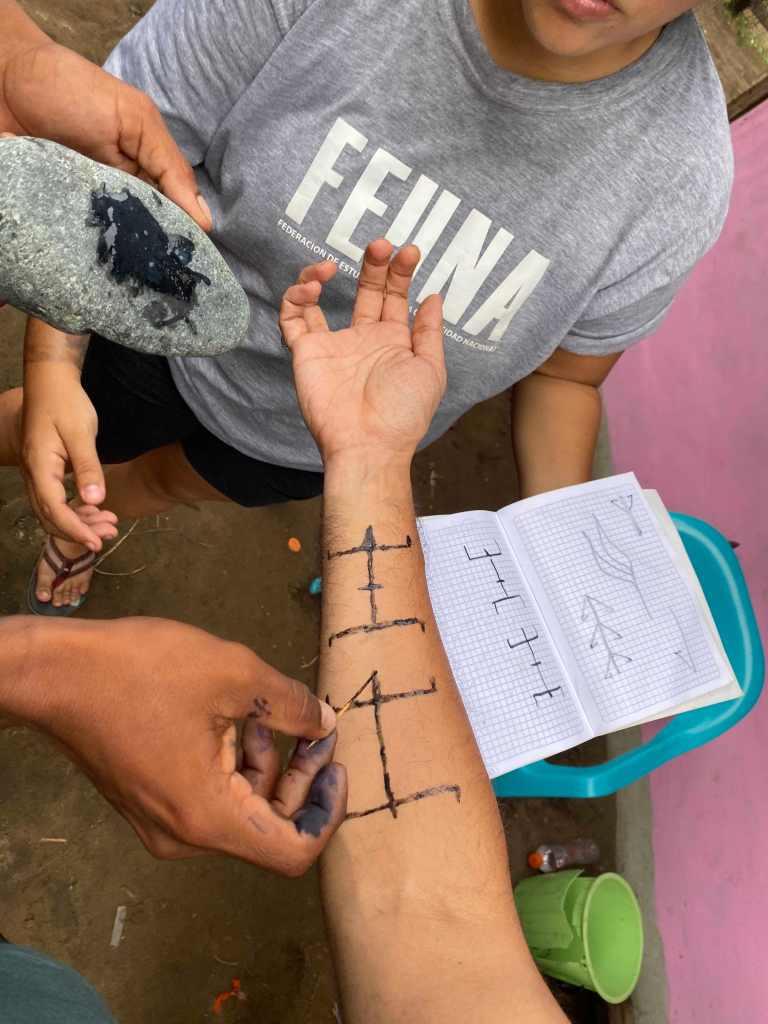
managed to find someone with jagua! We all take turns to get something drawn on
us. I ask for a mola of a frog on my right forearm. The jagua is potent and
smudges easily.
Going to the
mountain – a phrase that functions as an everyday rural excuse for being absent
from the party or from work.
A Last Supper joke:
“Waiter, a table for 24 please?” “Why? There’s only twelve of you.”
Charlotte’s web is
thick with the spiders she abhors. It seems that every day she sees a spider in
her room or one in the wild. Today, though, she lets out a shriek while I’m
packing. There’s a giant black spider in her shoe. It looks pretty dangerous. I
sweep it out with the broom. Hopefully it doesn’t return.
Today is
Angelique’s birthday. We sing her happy birthday in Spanish several times
throughout the day. It never gets old for her. Caroline says that the ‘happy
birthday’ song was copyrighted by Sony until just four years ago. So
restaurants had to always come up with their own rendition of the song.
Starfish is a colour.
Random thoughts
from Luz doing a reading of Caroline’s birth chart on the ascendant. The aim is
to be connected with the body, with its desires, to control and deal with it.
Too much lime takes away the enamel /animal in you.
Luz has bought
presents for the kids, and she got a solar system mobile for Zlatan. He’s super
stoked about it.
Dog caught his
girlfriend cheating with another dog. He couldn’t do much about it, though,
just stood around and growled.
We talk about
small pets we’ve had. Rabbits with tumours seem to be a thing. I remember Fuzzy
and Buzzy, two white mice that lasted about a year and succumbed to massive
tumors half their size. They were cute things that pooped everywhere. Luis
remembers caring for chicks as a kid with some friends but when they got ill
somehow they decided that the best way was to burn them. At the age of six.
It rains all
night. When I wake up at 6.30am, the storm is still raging. We haven’t had rain
like this since we arrived. Other than the first few rainy days it’s been
beautifully sunny weather. Laundry will be hell if the weather keeps this way!
There is an
insatiable urge to just sit and look and observe, what Rebecca Solnit calls an
“ecstasy of looking.” The curious child comes up to wonder what I am doing,
comes up to shout “Foto! Foto!” Is bored and wanders away. Women walk past
wearing their mola, their wraparound skirts and headscarves. This is everyday
dress for most of them, not just for cultural occasions. They are usually
carrying something; a basket of clothes, a bucket of fish, a child. On weekends
a man might be seen carrying beer or a bottle of rum to his friend’s house. The
men, though, work just as hard.
We watch the rain
and listen to the drums going through the village. It’s Panama’s day of
independence from Columbia today. When we first came, the beat was all over the
place. They seem to have got it together despite walking through the town in
the driving rain.
Luis looks at the
water droplets from the roof making tiny ripples in a trough on the ground and
remembers a battle scene from Macross. It’s a series I need to read again. He
observes that water is indeed a difficult thing to draw. Caroline’s friend once
asked a three year old how to draw water. He drew three overlapping circles.
She thought it was such a good idea she made a tattoo on her wrist out of it.
Still talking
about kids, Luis was really terrified of Donald Duck as a child. He didn’t like
Dr. Seuss either. He reckons that it was also because they could not talk. And
because they couldn’t talk they couldn’t explain themselves. And because nobody
explained anything to him, he was really scared. And as kids, objects and
unexplained phenomena, or even words grow to take on Goliath-like proportions
in your head. And you’re no David. Kids have no stone and slingshot in their
hand. And even if they did, would anyone even allow them to have a slingshot?
Certainly not in Singapore. Kids are too inundated with straight-laced
educational toys these days. A cup can only ever be a cup, not a world. Nachito
is only three and can already blow through a conch shell, wrestle a lime from a
tree and tie knots.
Why can’t we open
adult beverages and instead of alcohol there’s war, sex, or glory inside? –
thought from Caroline’s friend.
I crossed 20,000
words last night in the journal. It is quite a shock to think that I’ve written
so much in just under three weeks. Is it a badge of honour? Or maybe a sense of
loss for all the years that I pushed a larger kind of writing aside for the
concatenated punch that is a poem. But how much does a poem leave out? It is
like a photograph, except that a photograph is made and then it is finished,
the minor edit aside. Like a photograph, a poem is also a frame, excluding far
more than it includes. There is no art form that can fully encapsulate
experience. Everything is reflected, re-created in a likeness of reality. At
best, this is a shadow of truth. Which is why good art doesn’t just aim at
re-presentation but at transcendence.
After breakfast,
the sound of the flutes draws us to the basketball court. Panama Day
celebrations are in full swing and the rain has abated. There’s a long chicha
dance involving the flutes and the maracas and this time, I am able to get
permission from the schoolteachers’ to film a bit of it. Children are arrayed
around the basketball court in their classes, patiently watching. A bunch of
kids over to one side are clearly the marching band, decked out in pretty
uniforms, their drums lying on the grass before them, kitted in various
permutations of the national flag.
At ten, we gather at the Turtle House for something very special. Manuel, one of the sahilas and the village botanist, is going to give each of us a piece of heartwood. We troop over to his house. Thankfully, the rain has abated. He gathers a few small pieces of wood, elongated and shaped. They look slightly different from each other. We sit in a rough circle and wait for his daughter, Julia, to come and translate. Birdsong flits through the roof. The sun is weak, but gives the entire space a soft, gentle glow. At Manuel’s feet is a small aluminum pot that contains cacao being heated up. Manuel blows on the embers every now and then and holds the wood over the fumes. He speaks in Guna and his daughter translates. Luis completes the translation to English.
Heartwood is
actually the hardest part of the tree. Each piece we are receiving is from a
different tree. Some are varieties of almond trees, but the rest have only Guna
names. The wood is so hard that it can only be cut with an axe, not even a
machete. Julia explains that this is a very spiritually significant object that
is used for strength, protection and for motivation. It functions as object, or
it can be shaved off with a stone and drunk cold, as a kind of tea. One can
also put the wood into a bath. This is recommended to cleanse you of a negative
experience. One drinks the tea, about a litre of it, for thirty days at a time,
and it is forbidden to have sex during this period. Something about purity and
cleansing.
After the wood has
been heated up, Manuel sings over the wood. Julia explains that this is to call
the spirits from the mountain to inhabit the wood, which has been unlocked through
fire and song. Each spirit is from the particular wood we have. Each of us is
given a different kind of wood.
There’s a story
about Igua and Nispero, two of the trees that are used for the heartwood. Both
got into an argument about who was stronger. Igua said that I’m the best
because I’m the strongest but Nispero said that I get used more for tools such
as ax handles and so on so when I die, I’ll be surrounded by my friends and
those who love me while you will live on in the forest, alone.
Manuel then hands
a piece of wood to each one of us. The name of mine is ersu. I cannot get a
translation for it, though. My heartwood is pointed at both ends. It has a heft
in my palm. The grain is dark, striped, and almost animal-like. It feels alive.
And I guess it is in some way.
Over lunch we talk
about dyslexia and driving. Some people mix up left and right. Or yesterday and
tomorrow. Is it a kind of dyslexia, perhaps spatial or even temporal dyslexia?
And is dyslexia some kind of encrypted word that masks other things? Could
people with ‘dyslexia’ be less able at one thing and better at another? Is
there a kind of dyslexic equation?
The ground beneath us grows soggy with the rain. My chair soon becomes an island, maybe I will float away into the jungle. Before the rainy season, the mouth of the Armila river where it feeds into the ocean is narrow and boats can only pass by being pushed along by sticks. A heavy rain will change all that, raising the level of the river even as the ocean recedes. And on land, everything starts to grow. The dry season is really a season of lack.
Water is life. We are made and unmade from rain.
Stuck at Nacho’s house, Maria tells us about her various odd jobs, one of which was a summer job working as a garbage disposal operator, something that would be unheard of for the affluent, spoiled youth of Singapore. Caroline recalls how in Haiti there is no plumbing and so men have to shovel out latrines with their bare hands and buckets. It’s a hateful, but necessary job and it’s done at night so that the men are not recognized. Which makes me think of the Singapore nightsoil man in the 1960s and his truck full of drawers of shit that he would empty and replace underneath the outdoor latrines.
We trade our
favourite rainy day movies. Forrest Gump comes up. Toy Story and The Breakfast
Club too.
I start reading
‘The Book of Trouble and Spaciousness’ by Rebecca Solnit, a motley crew of
essay on topics as diverse as an Arctic artist residency, the Arab spring and
the birth of punk rock in America. Her writing here doesn’t feel as dense as
some of her other books, maybe because of the condensed space of the essay.
What I am taking away is how authoritative her voice is, whether or not her
self is embedded within the narrative. When she is observing events such as the
uprising in Egypt, she builds a particular subjectivity, taking an angle to
prove a larger point through dogged opinion that is more about concept than
experience. I do enjoy this point of view, because it allows one to comment or
speculate on things that aren’t immediately experienced.
After the rain, I
wring out my wet clothes that have just been washed for a second time. I do
hope they dry before we leave.
I carry on working
on my songs with Luis. We manage to translate two of them into Spanish, because
the translation app I used was way too literal and had no poetry in its head.
Such is the poverty of machine translation. Luis does have a way with words,
and a couple of times, a synonym he suggests that works better in Spanish has
me changing my English lyrics to match his.
Rain stops and we
watch the evening unfolds slowly in front of the house. A man takes an hour and
a half to chop up an old canoe. He stops regularly to chat with people and to
help his buddies draw up another large canoe onto the bank. People here really
do live from farm to table to fire. Soldiers make regular rounds around the
community. It feels like military presence has been stepped up since the
robbery.
Somehow, when
there is heavy rain there is no running water. And there’s barely enough power
to turn the light on. No one is charging anything tonight.
We are trying to
get jagua to draw something on all of us before we leave. It would be a good
memento if done right. The pigment is colourless and comes from the fruit of
the tree, which is only found deep in the jungle. Apparently a couple of people
in the community have it, although most of it was expended during the chicha.
People often mix it with some charcoal so they can see what they are drawing on
themselves. I offer my arm as canvas. Hopefully no dick pics will emerge!
We will visit the
beautiful mouse on Wednesday. It’s some kind of large rodent that someone is
keeping as a pet. I think beautiful mouse is some kind of unfaithful translation
that ended up as a joke. Also because we can’t figure out what kind of rodent
it is.
Maria mentions
that she found mouse poop on her mosquito net. Luz thinks it is oshin, some
kind of ash or residue. Luis laughs at her pronunciation. He says that it’s
oyin and mentions that Oshin was the name of a Japanese soap opera. And I do a double
take, because I watched that as a teenager on bored afternoons after coming
home from school. How things travel!
Part of our dinner tonight is chicken, which is no big deal, except that it came from a rooster that was found dead. We speculate if it was killed by the chupacabra, a half-mythical creature that sucks the blood out of young men, some kind of less lovely pontianak. But Nacho thinks the most likely explanation is that a falling coconut killed it. This is extremely funny and sad at the same time.
It takes an
eternity to fall asleep. At one point I imagine that I’m flooded with small
ants that are slowly turning inside of me. They revolve and make me feel really
warm. It’s odd, because I have never had any problem going to sleep before
while here in Armila.
The chicha is well
and truly over this morning. I think they were going all the way to midnight,
the cut-off point and then after midnight, complete silence. But this morning,
some locals are determined to keep the party going in their houses, swigging
beers and dancing drunkenly about. The majority of the men, though, are down
for the count. When I step out to get my clothes off the clothesline, there are
a few men in a couple of canoes pulled up onto the riverbank. One claps, and
the other one claps a bit more, then the first one claps again. And then they
all laugh together. It’s quite hilarious.
Part of me feels
like I should have spent more time in the chicha house, but that would have
meant accepting more to drink. And it was really pretty strong. Also, none of
the other artists were inclined to hang out. I guess after the first night,
everyone was a bit wary. Also, the constant tobacco smoke really sears the
lungs. I could barely swallow my food after that first night. I can’t imagine
the state of the tobacco blower’s lungs. Maybe they resemble the interior of a
corroded steel pipe. But I am also reminded that this is not a tourist
experience, that this is part of community life, albeit a rare and more
significant occasion. The chicha is for them, and they are being polite and gracious
by allowing us to observe, and even participate. So I am grateful that we saw
as much as we did.
The mice came down to play in Caroline and Maria’s room last night. Caroline kept flashing her light on them and they would dart up to the rafters again. One of them bit through her salt pill. To replenish lost minerals and all. They had a pool party in the tarpaulin that hung above the mosquito net in Charlotte’s room. It works as a catchment, but also as a small pool for the mice. We suggest leaving Lluvia, the cat, in the room. She may just be a kitten but the other day, she defanged and ate a scorpion! Super badass.
Over breakfast, we
discuss things we need or want to do with the time left to us. I haven’t yet
crossed the river to the other beach. There’s also jagua, kind of temporary ink
like henna that we could make to draw tattoos or body paint. Caroline wants to
make more audio recordings in the village. I haven’t yet received permission to
fly the drone, and may never will. It feels like you need three months here to
work at something more extensive and layered. Three weeks is way too
brief. There will be an open studio at
3pm on Tuesday, and we’ll show or speak about what we’ve been working on.
I don’t want to go back to the plastic world.
We have difficulty
telling Guna women apart. All Chinese people look the same to me. Maria calls
it face blindness. Apparently it is a thing. Maria has it quite severely. I
recognise faces but not names. Is there such a thing as name blindness? Or am I
just not able to fire the right synapses because I don’t want to? But this
sense of not being able to recognise people you are meant to recognise can be
very draining and does cause loads of social anxiety. It’s like having an app
open on your phone that drains the battery without you realising it.
There’s a
particular seed that some of us have been collecting from a particular section
of the beach. I call it a hamburger seed. Maria has seen it elsewhere and think
she knows it as crow’s eyes. Luz thinks it comes from the rubber tree, which I
doubt and Luis says that it is hollowed out and used to hold a joint, a ‘roach
clip’.
Words / don’t tell much anyway. / To know the bones / of a thing you have to go down deep, down / to where the seagrass roots and even debris – / a coke can, a boot, a purse – can be a crab’s / nest or a trap.
– From ‘Fishing at Hermosa Pier’, R.J. Cantalupo
As I am sitting
and updating my journal from last night, I see a small lizard in the bowl of
celebratory gummy bears that we had used as a ‘cake’ for Bernie last night. The
lizard is slowly but steadily licking the sugar, now slightly wet, from each
bear. Shifting its webbed feet very imperceptibly, the pocket of its lungs
moving, a tiny bellow. Suddenly, it turns and leaps and lands, perfectly
poised, for escape. It is nothing like the dark, dirty-brown lizards back in
Singapore. This lizard is yellow and green, dusted with sunlight.
Over lunch,
chicken porridge, we listen to Latin music. Porridge is sweet in Iceland; they
cook it in milk (like oatmeal, except Icelanders cook oatmeal in water!) and
then add cinnamon sugar on top. They usually eat it with blood sausage.
The song we are
listening to is a merengue and we debate the differences between vallenato,
cumbia and the song after that, a bachata. The cumbia is drum and percussion
heavy and originates from African rhythms. The vallenato is music that you
listen rather than dance to. It folksy, with an accordion and is from Colombia,
with valle (valley) alluding to its rural origins.
The batchada has
very typical guitar lines and is a lot faster. The vallenato is what we have
been hearing a lot throughout the community these past weeks. So much to think about!
After lunch, we
pass by Dog as he is humping the dog from the Internet cafe. We are ashamed for
Dog and Caroline tries to get him off but he gets turned around. And stuck.
It’s doggystyle in the most painful way possible. Luz said that there’s a
specific word in Spanish that describes this, ‘abotonados.’ I look it up and it
comes out as ‘buttoned.’ Pretty apt.
I get into a
conversation with Charlotte and Caroline about artistic process. Both of them
keep versions of their work while I usually edit over what I am doing. And I
rarely return to my old poems to mine them for new material. I usually write
from nothing. Caroline is very easy-going and not very adamant about keeping
her old sketches. But her husband would fish out scraps of sketches that she
had thrown. She’s says it doesn’t matter to her, she’s already gotten what she
needs out of it. Charlotte is very afraid of starting from scratch, so she
starts by sketching found objects like rocks and then moves on to imagined
vegetation. I sketch photographed objects in order to slow down how I think
about them and then I write a poem as a way of layering thoughts onto the
subject matter.
The village is on
lockdown because of the robbery yesterday. All the kids are not allowed to play
in the streets. But there’s a football game of under-7’s going on in the yard
across from ours, where I am napping in the hammock. Somehow, they have decided
that they need a referee. Who is dressed all in black and blows his whistle far
too enthusiastically. Maybe without a referee, fights would break out and the
game wouldn’t be as fluid.
We take a walk
after five down the beach and back up ‘Coconut Way,’ a lovely, shaded walk
through a coconut plantation. Today is clouded over but at this hour the light
through the palm leaves is gorgeous. People are coming back in their canoes
with supplies for the week. Maybe they made a run to Puerto Obaldía or made a
trip upriver to their fincas. Either way, people seem to have largely sobered
up. Maybe the chemist, who made the chicha, Tigre, also made a hangover cure
for everyone.
Moths are night butterflies. Does that make them evil?
I thought about
going vegetarian on this trip, but decided that it might just mean that I eat a
lot more carbs, although the meat substitute is mostly eggs. But if I had done
so, I would have missed out on the iguana. As Maria puts it, she’s a
culturerarian; she eats culture. So true. I can always get back to veggies and
beans and cut the carbs and meat down when I’m back.
The whole village
has chicha in their veins. Lying in bed, I can hear a constant wail of noise
that rises and falls. It is like a sea, punctuated by the hoots and cheers of
women.
Meals are sparse
during the ceremony. Breakfast is boiled yuca with a single sunny side up. It’s
also because we have run out of vegetables.
Women are sat
together in the temporary house. Only women are allowed in, but the men loiter
outside, looking in. The chicha music comes and goes.
Drunk language is
English. It’s great how everyone practices English when they are drunk.
After breakfast
the women all sit in and around the temporary house. The immediate family and
relatives of the girl sit inside. All women. They will begin the ceremony of
cutting her hair at 10am. Buckets of dark looking chicha are drawn up and
passed around.
I follow the men into the chicha house. It’s barely nine in the morning. There are two singers in the hammock; their singing is more of a half shout, atonal, continuous and punctuated by the rhythmic maracas that they shake in their hands. The smoke palls all around, it heats up the house. We are brought a small tortuma of chicha. This time, I take small sips and chase it with water. Then they bring Luis a large tortuma. He manages to down half of it and passes it to me. The chicha has fermented even more over the past two days. It is dark, almost fizzy and very, very strong. But because we are not expected to drink it all at once, it is a lot more palatable.
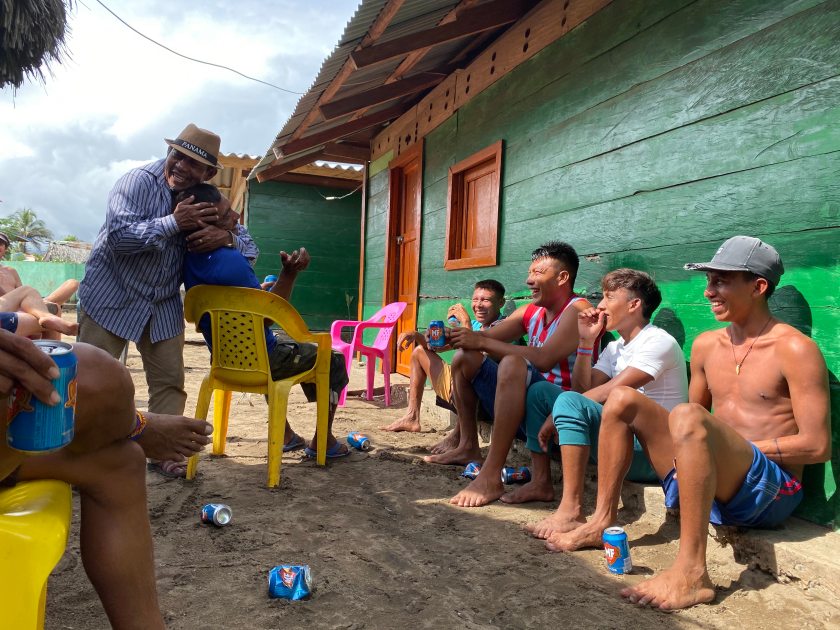
All the men have to vamos from the chicha house and from the house of the women. We walk past the basketball court and pull up plastic chairs. Someone hands all of us a beer. Luis, who is gluten intolerant, goes for his usual rum in a mineral water bottle. Ramiro Martinez, drunk as a skunk, draws ‘thank you’ on the sand.
Lucho mara leche
means Lucho (Luis) is bad milk. It’s a drunk joke from Ramiro Martinez. I
suppose it means the same as a rotten egg.
The tourists are
still here. Apparently, their boat driver is too drunk so they will only leave
tomorrow. The two French boys are engineering students and they are taking a
gap year to travel and work on various ecological engineering projects. Various
organisations and their university fund it. This is the holiday portion of
their trips. A pretty good gig. While students in Singapore rarely take gap
years and sometimes overload their semesters. And holidays are spent on
multiple internships, maxing out their CVs. What a dank life.
Doing laundry
while slightly high is like an act of cleansing. Rinse, soap, wash, wring.
Repeat.
Luis is in the
other house, so we work on a spoken word piece and another lyric that I wrote a
few days ago. We are both not fully there but the art takes over, and we are
able to concentrate and figure out something decent. The girls have gone for a
beer and are still at the women’s house. Just as we are starting to record a
demo of our song, I’m incredibly distracted by the sight of a naked man walking
up from the river after having taken a shower, looking like a pudgy yet
muscular vision of John the Baptist.
At the women’s
house, women put oil in their hair and powder on their faces. According to
Maria, she felt like a baby for a while. Everyone is drinking, of course. The
girl’s hair is cut in rows, very slowly, close to the scalp.
Verónica comes
back to Nacho’s house around lunch to apply sunblock. She tells me that the
ceremony is still ongoing. I walk over for a peek. It’s just a horde of drunken
women in there. The girl is still in the hammock.
Igua doesn’t
drink. He’s working on a watercolour painting and seems to be disinterested in
the chicha. He also wears a cross around his neck. I wonder if he’s the
designated adult for the house, or whether he objects on religious grounds.
There is some
concern about having allowed the tourists’ to be part of the chicha, because
they were not briefed about protocol beforehand. This resulted in some
uncomfortable moments, and apparently one of the French dudes grabbed Nacho’s
ass at some point 🤪
Even the rooster needs to step out of the chicha house for a break!
Nague made lunch today, because Aida was out drinking.
Charlotte,
Verónica and Maria return and between the three of them I try to piece together
what happened during the ceremony.
There were five
women sitting on towels on the floor and one in the middle was holding the
girl. It’s the aunt of the girl, because the mother doesn’t drink alcohol and
so she isn’t allowed inside. Something powerful here about the relationship
between alcohol and permission. A woman on their left was chanting and across
the women was three low stools with women who were smoking tobacco and cacao in
containers as incense. Other women smoked tobacco in the faces of the other
women who lined the house.
Behind the women
of the girl was the woman who would cut the hair. Her name is Iét. At one point
the chicha finished so everyone collected money to buy beer. They poured all
the beer into the chicha bucket and passed it around like it was chicha.
The women cut one
lock of hair at a time in lines. They started in the centre and moved outwards.
Men came in and they painted them with red pigment and powder. Then everyone
ate dried fish and plantains. The men left.
When the girl was
bald they undressed and washed her. They carried her and washed her near the
house. They put some leaves and dressed her in a new, white mola. Whenever they
carried her they were dancing. The girl was always wearing a scarf on her head.
They put a leaf on her lap and a veil on her whole body.
Iét started singing again.
At some point the
men came in again and held the hand of the singing woman. The woman sang to the
men and then they left.
At the end they
pulled out a hammock and put the girl in the hammock. The formal element was
over and everyone relaxed and took photos and told jokes.
After lunch, the
men are still singing in the chicha house and there’s still a group of men
smoking around them. Chicha is still being passed around. At this point, people
are staggering about or starting to walk sideways like crabs. A wall of a
nearby house, made of sticks, has collapsed. But all in all, it’s not raucous
or manic.
Suddenly tired, I take a nap while listening to Mumford and Sons, ‘Delta’; Then I read bits of Anis Mojgani’s book, ‘In The Pocket of Small Gods’; terribly devastating but also deep and true.
Everyone writes or draws something for Bernie on small colourful cards that Veronica has brought with her. It’s her birthday today! I write her a poem.
 Wish
 (for Berenike, on her birthday)

 Each stroke of your brush
 is a journey towards another story.

 Everything finds light
 under the sunshine of your touch.

 Unfold flowers from lost things,
 give them new names.

 Hold yourself
 up to the sun,

 that you may sew new colours
 across tall fields of grass.
A large group of
men and women return from the beach looking very drunk. One of them is holding
an empty chicha bucket. They certainly weren’t building sandcastles. Luis says
that they went swimming naked in the sea.
Back at the house,
Caroline, Maria and I start talking about Sellavision and memories of home
shopping. It’s always things that we never needed but the people with
pearly-white smiles and $39.90 deals always won us over. Plus if we ordered
right now, they would throw an extra thingamajig that alone was worth $39.90.
Just think of the value!
From this, we
sidetrack to contests at the back of cereal boxes. Caroline has a great story
of when her mother was a kid and she drew a pirate and sent it in and some time
later two men showed up at her door, wanting to offer her more prizes because,
“You’ve got talent, kid” I ask if Caroline’s mother eventually became an
artist. She was a homemaker and after twenty years of raising kids, returned to
work in a nephrology unit at a hospital. When she started she couldn’t figure
out how to check her email!
And then, drama!
Someone broke into the other house and when Bernie, Charlotte and Veronica
returned from a walk, they heard a loud clatter but weren’t quick enough to see
what it was. Apparently, a young boy, fourteen, had climbed in through the
bathroom window and rifled through Bernie’s things, stealing money and a power
bank. She was very affected because earlier this year, she had another incident
in London where thieves snuck into her apartment and made off with her
suitcase. And it happened when she had come home and caught them in the act.
But there was no way to retrieve what she lost then, and that fear feeds into
what has just happened. Fortunately, some ladies saw the boy climb out the
window and told Aida, who went on the warpath and set a neighbourhood watch out
for him. He stupidly tried to buy juice at a store and was caught red-handed.
It’s a small community, and there really is nowhere to run. The boy is a
recalcitrant. This will be his third strike. Apparently he had already been
hauled up to the council before for being an unrepentant smoker. We manage to
retrieve some of the money, but Luz says the family will return everything,
although a power bank is still missing. But it’s more about the emotional toll
on Bernie as well as the shock of something like this happening to us.
The Internet lady has more power than the sahila in this village. Another quip from Caroline.
The chicha is
still going on, but people have already started going back to other
communities. In the chicha house the men continue to surround the cantule, who
seems to be singing all the way to the merry end.
We sit outside
after dinner. The stars keep changing colour from red to blue to green to
white. A star has just turned off. Maybe it was a satellite that expired. Maybe
the star’s light finally depleted, millions of years after its death. Strange
to think about legacies and the kinds of light they emanate.
We talk about spending
time in airports. Luis moves from that to the time when he lived through an
earthquake. He was a kid and traveling with his family. They were meant to fly
that day from the north of Chile, but the flight was overbooked. His parents
were incensed and argued for hours but they weren’t put on the flight. They
refused the offer of a hotel to spend the night so the family went back to a
house they had in the city. At night the entire house started shaking.
Everybody ran out. The aftershocks lasted through the night. A lot of buildings
collapsed (maybe even the hotel they were supposed to stay at!) and the airport
was closed for two weeks. If they had made that flight, they would have escaped
it all.
I wake up around
9am but can’t get out of bed until 11. People in the house behind are talking
so loudly it seems like they’re shouting right into my ears. It’s incredible
how I have taken walls for granted all my life, the fact that they block both
sight and sound.
Verónica joins me
for breakfast. She tells me how around 9 this morning, she saw a large group of
women walking back from the far end of the beach. They were stone drunk, and
some could barely walk.
Apparently someone
entered Caroline’s room at 5am and shone a light on her face, jolting her
awake. The intruder then ran right out of the house. It’s a mystery, and our
best guess is that someone couldn’t find the way home.
Bryan Adams is
playing on the Bluetooth speaker at Nacho’s house. The familiarity is
surprising and suddenly welcome. Maybe we just had a collective nostalgia
attack for 90s rock. Or maybe we are all hung over.
The kids are
trying to slaughter a chicken. They manage to hack at its neck but lose control
when the chicken panics and darts away. They spend the next twenty minutes
running in all directions, chasing a chicken with a rather severe neck wound.
I’ve read that chickens can still survive for quite a while even after their
heads have been cut off. I’m sure there’s a physiological explanation for this,
but it’s a nice parallel to how life can still carry on even when you literally
(or figuratively) lose your head. You learn to depend on other things, trust
new people, find a better path of escape.
Two young boys
help an older man to weave his way up from the edge of the river after peeing
for an eternity on the side of a boat. He is wearing a t-shirt that has the
name of Panama’s current president, Nito Cortizo, emblazoned on the back.
Many of the men in
the chicha house have walking sticks with them. I’m sure there’s a ceremonial
significance, but when you’re drunk out of your mind, they really make a
difference!
Today is a quiet
day for the chicha ceremony in terms of specific activities but we may all head
over after dinner to drink a bit. I think one tortuma is all I can manage. I
ducked in for a second after lunch to see what was happening and the hammock
was up, the cantule was sitting on it but as far as I could tell, everyone was
speaking the same language of drunk.
Chicha is a most powerful drink.
Around 5.30pm, I
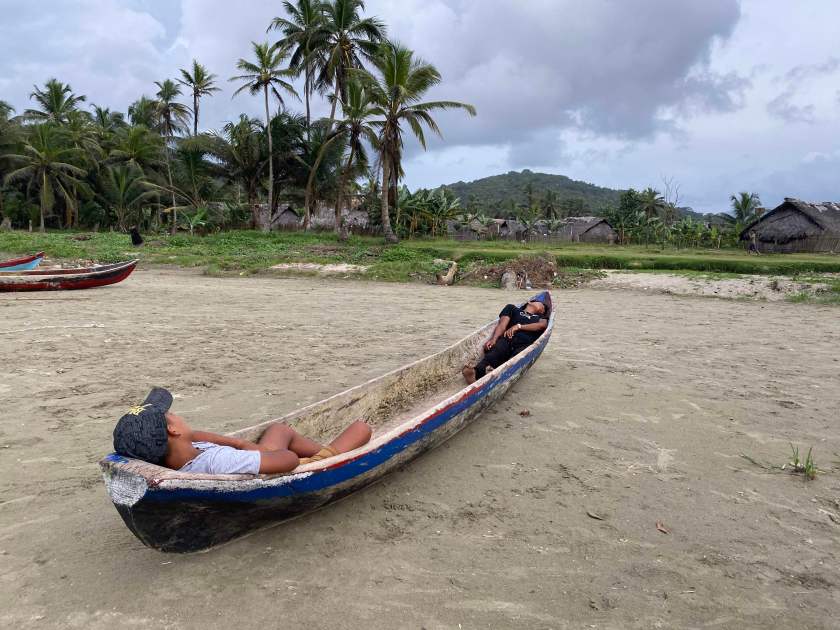
put my work away and go down to the beach. Groups of men are stretched out on
the grass, and one canoe holds a couple of sleep- addled dudes. I sit on the
edge of a canoe and look out to the river and the sea just beyond. I think this
is the first time I’ve ever sat down to just observe the end of the day. I’m
always foraging on the beach for natural objects, looking down and occasionally
racing out to catch a purple pink sky. I need to do this more for the rest of
my time here. Just be with nature.
I’m close to
completing my self-assigned quota of poems. I am two away from 25, and am
pretty happy with my output. It’s time to put the pen away and go out
exploring.
In the chicha
house, the cantule is definitely in some kind of trance state, helped on by a
constant curtain of smoke.
We get into a discussion of the word ‘bitch’ after dinner. On whether women bosses are always, by default, seen as bitchy. And how alpha females are more than bitchy. The power they hold is somehow more ascendant and dominant than the state of being a bitch, which carries negative connotations of unfair practices and attitudes. So what do we mean when we say life’s a bitch? That its inherently unfair? Yes, but that its also a slog.
The women are in a
unique position of power and silence here. Or at least, that is how it appears
when you blend daily life and cultural practice. Men can enter the chicha house
dressed any way they like. Women have to wear a mola blouse and a particular
wraparound skirt. The women clearly have to cook and handle household chores.
The men hunt and seem to have the license to drink more openly. But certain
ceremonial rites are separate from the men. The men are the ones drawing the
chicha from the gourds. The men blow the tobacco smoke and are the cantules.
The town is up at
5am. It seems that everyone has congregated outside my room. I’m exhausted from
the mosquito bites that kept me up last night and can’t haul myself out of bed
to see what’s going on. I’ll go for a walk around the town at 7am. The
neighbours are hosting some out-of-towners and they were talking, laughing and
watching TV until pretty late last night. Their stamina is amazing.
On the way to
breakfast I decide to walk around for a bit and near the chicha house, I see at
least thirty men hard at work building a temporary house. While it has the
frame of a traditional house, the walls are made of thatch and they don’t go
all the way up to the roof beams. It will be used at some point during these
three days, though it’s unclear what it’ll be for. Nobody really has a
‘schedule’ for daytime activities, although we do know that the ceremony proper
starts at 8pm tonight and will continue throughout the night.
There are a
disproportionately high percentage of albinos in the village. We aren’t sure if
it is a birth defect that’s hereditary or that the Guna are more predisposed to
this genetic mutation. But they have their own way of dealing with them.
Albinos, rather than being shunned, are seen as visionaries because their
natural sight is impaired or extremely sensitive to sunlight. So they are said
to be able to ‘see’ in other ways, as shaman-like figures.
Luz used to call a
toe a foot finger for years. It’s both cute and quaint and immediately gives
the toe a bit more credibility.
Caroline and I
trade fan boy stories of David Sedaris. Apparently, all he does now is walking
around his village in the UK and pick up trash.
Google doesn’t
work in Iceland; the algorithm doesn’t work for such a small number of people.
You either have to search for something specific that you know or you ask in
another language and then translate. Perhaps life would be better if less of it
could be found so easily.
During the Chicha ceremony, there are flowers on the nivar stem placed around the houses as a ward against bad spirits. Plants are sisters that protect us from other layers and worlds.
Those who can see beyond the natural world travel through various layers that the Guna belief existence is composed of. And in their travels they make a space for lost spirits, people who have died unnaturally and have not passed to the next world. These traveling visionaries are able to build a house for these spirits in a kind of middle space.
People who die naturally, on the other hand, have to be placed under the soil to be reborn and the Guna make a soil belly, a mound for Mother Earth above. This is such a difference from the Torajan people in South Sulawesi, Indonesia, who believe in the sacredness of the ground and so bury their dead above the ground, carving niches in rocks and dangling coffins from cliffs.
The Guna also have particular practices when it comes to animals. If a snake bites someone and the snake hasn’t been killed, no one can leave the community for four days and everyone has to drink a special serum prepared by the botanist.
Later on in the morning, I sneak a peek into the chicha house. The men are moving back and forth in a line. It looks like a rugby scrum, but half the men are carrying tortumas, and the other half drink out of them. Then they swap. This could be practice for later, although they do seem to be drinking the real thing.
In the evening, I
make a small totem from a stick and a seed that looks like an alien face.
Inspired by the niva, it will be our ward during the chicha.
 I Dream of Medusa
 Material: seed, bamboo stick

 When the jellyfish come
 they will be in bobbing clouds
 of soundless bodies, wild
 tentacles grasping the sky.

 A touch is electric enough
 to entrance and turn us:
 not to stone, but husk;
 empty of desire,
 floating in their wake.

 We keep them dried,
 carefully planted at corners
 of houses; may whatever
 darkness that tries to enter
 look them in the eyes.
I try to sketch a
dice that I found on the beach. It seems easy but I really struggled to get the
angles right. It’s a lot harder with small objects.
A boat arrives
from Anachucuna. It’s about the size of the boat we were on yesterday. Packed
onto it are 30 people, all men. It sits really low in the water and takes an
eternity to navigate into the mouth of the river. A sizeable crowd is waiting
onshore to welcome them.
When Nacho was in
La Miel with Veronica this morning shopping for supplies, he met four tourists
who had come from Capurgana. They are a mix of young French and Germans. Being
Nacho, he offered them his cabins at the end of the village and invited them to
experience the chicha. They also had meals at our house. Instinctively, I feel
slighted that they could just rock up and attend such a significant ceremony,
but when I thought about it, the importance would be lost on them and they
would see it as a ‘wild’ native ritual, whereas we have had a couple of weeks
to prepare and learn about it.
All ready to observe the chicha ceremony!
We enter the
chicha house after dinner, at 7pm. The actors, who are those who serve the
chicha, smoke enough tobacco for a year of cigarettes. They light their wooden
pipes from dried tobacco leaves. Smoke fills the house, thick and sweet. They
wear necklaces made from pelican bones, long and thin. It jangles to no
particular rhythm. Everyone gets his or her face and feet painted with the
paste from the plant that is used as protection from sunburns. When that is
done, the chicha begins with a pretty tasty corn chicha. It’s non-alcoholic.
Then some men form a line and fill an entire canoe with the real chicha. That
takes a while.
This is the canoe that held all of the chicha!
When it’s ready,
servers carry tortumas, which have a handle of bone tied across the mouth,
making it easy to hold and to dip into the canoe for refills.
When you’re asked to drink you have to drink, all of it, and not too slowly at that because there’s another round of guys waiting behind. Each set of men is 8 servers and 8 recipients. Because in Guna mythology, the sun has eight brothers. Each tortuma holds the equivalent of two to three glasses of wine. It doesn’t hit at first; but after four rounds I start to feel really uncomfortable. A fifth round would probably make me puke, so I duck out for a toilet break and to make notes.
The men and women
are separated; and the women were yet to drink when I left, although a small
group of older Guna ladies hung by the canoe, where the canoe servers gave them
tortumas, which they shared among themselves. Nowhere near the binge drinking
of the men, which is something serious. Luis’ trick is to spill half of the
liquid down the front of his shirt, which is the same colour of the chicha.
That’s how he survives. I might have to start doing the same!
Apparently,
dancing and singing myths will start at 2a.m. I will try to get up then.
Around 11pm, I wake up. The girls are back for a bathroom break and I’m pretty high. The alcohol has fully soaked in. I mention something about being a frog and saying that Luz is a rainbow. But I don’t feel absolutely terrible so I follow them back, deciding to stay outside and not to drink. Luis is still there, incredibly, but he’s pretty wasted. Nacho has somehow made it through and he’s on his feet as well. As I’m sat outside, though, a bowl almost immediately comes to me, I take a sip, gag and hand it to the German tourist next to me. I race (or lurch, rather) to the toilet and am violently sick. But better out than in. When I rejoin the group they are making exit plans to hang out in the beach behind Luiz’s house, a Guna local who looks like a muscular Bali boy, long hair, quick smile and all.
We grab chairs and
beers from his house and sit under a partly cloudy sky. The stars are dazzling
and somewhere over the ocean, there is a lightning storm going on.
At some point we
get up to help Luis into the house. He kind of fell asleep on the beach for a
while. At a later point I decide to walk to the ocean to pee. Beyond the lights,
there is a sharp line of darkness, I head for it, and promptly fall down a
small slope of sand. This part of the beach is quite steep. I stay on my feet,
water lapping around me, and try to climb back up. I cannot. And in my silly
state of mind, I had decided that this was the only way up. I must have looked
like a large, dysfunctional crab trying to crawl out of a too deep hole.
Fortunately, a light comes bobbing my way from the other end of the beach. It’s
a local Guna man, and I can’t tell him anything than ‘Si, claro’ because I
presume he’s asking if I’m ok. But by his light I can see that the beach
becomes a gentle incline a short distance away, and that allows me to get back
up. Also, why are there so many canoes on the beach! Someone could totally trip
over or into them.
Tilting her head
back, the stars make Veronica feel like she is melting. She pukes.
We head back to the chicha house around 3 to see if they have started the next stage of the ritual. Two pairs of men stand on either side of the central portion of the house, holding a rope in their hands. In the middle, more men are working on putting together a large hammock. Everyone stops frequently to drink. Designated tobacco smoke blowers dance around, blowing directly into the mens’ faces. At some invisible cue, the pairs of men crisscross each other, taking turns to duck under the rope. They are moving fast, using the rope to break their sprints. This is how the main rope that holds the hammock gets woven. The hammock will be for the cantule, (the main singing sahilar), who will recite the names of the girl. Yes, this whole ceremony is about one girl. Although it is also a chance for the Guna to celebrate an important part of their heritage, something we haven’t really seen in the village. Daily life, while simple, still revolves around the trappings of modern life; televisions, mobile phones. The ceremony is primal, intense and raw. This is no packaged cultural show put on three times a day for busloads of tourists.
A little later on,
a few men and a couple of women gather in a line and do a kind of dance/shake
with maracas. They seem to gravitate toward the different pillars that support
the building. They shake and roll and then stop (to drink chicha) but also for
the lead dancer to blow a low, sonorous note into a pipe. It seems aimed right
at the pillar. No one is around who can explain the meaning behind this.
Music has been
everywhere in the time I’ve been here. There’s always a Latin bass line going
on somewhere and traditional music fights for space with auto-tuned pop. The
chicha house reverberates with the sound of men urging each other to drink,
women chatting on the periphery, and the maracas of the dancers, an ebb and
flow of dancing tension.
Maria offers a
great thought, ‘We are made of rhythms.’ And it’s so true. Our heartbeat is our
first drum. We depend on rhythm to stay alive.
I leave at 5.30am
to sleep, exhausted by the constant tobacco smoke, having to dodge tortumas and
the long night. Outside, a storm is passing over the town and it is just
beginning to rain. The sky is lightening and soon it will be the second day of
the chicha. There are at least 100 people still in the chicha house when I
stumble home.
There’s a poster of all the months of the year pasted on the wall in Baudeliano’s front porch, with the Guna names written below. Nacho helps to translate:
Yornii– the beginnings of things Arrinii – the arrival of the iguanas Dilanii – seeds from a palm Olornii – cicadas that predict the sound of rain and herald the start of the planting season Yaugnii – the arrival of the turtles, attracted by the moon Masarnii– wood that the Guna use to build houses Bunurnii – blossoming of ceremonial flowers Gignii– the sea that recedes Apinii – another medicinal flower Guiblonii – the ocean floods, butterflies and birds migrate Inanii – the returning birds Bardunnii– flowers used to heal
The names we use are based on the planets. The Guna base their names on the phases of the moon, which is seen as feminine symbol, and the seasons.
Luz drinks mate
every morning. She has brought bags of it over. It’s a kind of tea, but very
strong and there’s a technique to steeping it. She tops it up ever so often
with hot water to ensure the strength and consistency remain. She has a special
mate cup and a straw made completely of silver, which doesn’t colour the taste
of the mate.
Caroline isn’t
feeling so well. It was probably a spell of being exposed to pretty intense
heat yesterday. She has no appetite and rests in the house while we go to
another beach. The weather plus the mozzies and other small biting flies can be
harsh.
In the boat, I start talking about how Singapore has denied itself as an island, with its intimations of a slow, idyllic life. We eradicated the kampungs, terraformed the landscape and even subjugated our outlying islands, merging them or reducing them to landfill. I wonder how villagers who used to live on Pulau Semakau feel about how their island is now a heaped pile of trash. We are City. A city breathing in the state of its reinvention, or maybe this is who we really are. We are no island paradise; we are a business hub. If you want an island, you fly elsewhere for the weekend. On weekdays, you work to pleasure those who are constantly remaking the city in all of its imagined ideological flex; through the external and internal landscape. For we have denied the old roads inside of us too. Forgotten languages, dialects, habits, rituals, ceremonies. Things that ground us to earth, to history. Instead, we are taught to yearn after the gods of capitalism, a faceless thing that is no real god, but a bottomless greed that never stops demanding our worship. We have lost our truest shape, and for what?
This beach has
very different vegetation inland from yesterday’s beach, which was on the edge
of the jungle. This fronts a sprawling coconut plantation. But there is a
strange fruit that looks like a small sour sop that grows here. It isn’t
edible, but the fruit can be used for shampoo and for burns. It’s incredible
how people have figured these things out. Imagine the process of trial and
error!
Snorkeling here is
pretty satisfying. There are hardly any shells here, but the water is less
choppy and I manage to film a bunch of pretty fishes and some coral that are
bunched around a large rock. The world is so different underwater. I can
completely understand why we are so taken with it, and how people are addicted
to diving. It is escape and meditation, a kind of contemplation of a natural
state (if you ignore the odd plastic bag and container drifting by). A jellyfish
bobs in front of me. I instinctively start to reach out for it, something
unknown, tantalizing, then stop short. It drifts away, heedless.
Over lunch, we are joking about how Maria has sewn a strip of mola with a crab motif, but no she didn’t just sew it, she made the tablecloth the chair, the table, even. Overnight! And Luis says that we are dreaming rather than just inventing. But it is also a nod to the incredible skill of the Guna. They build their own houses. They sew their own clothes. Of course, they aren’t entirely self-sufficient, but they won’t starve or be homeless either. I would probably not last a week out here in this terrain. All my skills are honed to thinking and reflecting whatever I see. I am dreaming against another reality.
Out of nowhere
Bernie says, I think I am made out of bites. And all of us agree. The bites
burn. They are a constant presence, a reminder of our place as strangers here.
When we return to
Armila, a soldier waits for us holding a piece of paper, the best kind of
weapon. He is probably tracking the visitors that are coming in for the chicha
ceremony.
Nachito is all of
three years old but he is already so intent on possessing. He lords over the
cat and proudly leads the dog around on his leash, proclaiming, ‘mi perro’ (my
dog). But do we ever really own ourselves? Even when we are fully grown, we are
expected to own up, to own this. To own is to possess something tangible, of
value. We own houses, cars. Companies. We used to own people, too. But do we ever
really own ourselves? What does that mean? I’m in a conversation with Caroline
and Maria about this. Maria offers an example of two men who are the only
permanent residents on a small island off Iceland. They absolutely hate each
other’s guts but are intent to remain separate, cut off because they each
believe they own their individual right to anger and isolation. And Caroline
recalls that a few years ago, she used to see how in the alley behind her row
house how a woman would come and break up an entire loaf of bread each morning
to feed the birds. And as soon as she had scattered the bread and went back in,
her neighbour would open her door and let her fat basset hound out. He would
waddle over and hoover up all of the bread. I suppose that is also way of
owning space, by contesting it in a passive fashion.
Today I help Luis
to prepare dinner. We use what we have, which changes every day. We also try to
vary the routine. But it also depends on how imaginative people are. I just
help him dice carrots and cucumbers. We make vegetarian pasta with a small
topping of courgette in lemon and balsamic. The pasta is barely enough, but we
used up all three packets. All of us are always hungry here, despite the fact
that I hardly eat carbs in Singapore for dinner. Coffee is a large pot with one
packet of coffee powder and Luis cuts a swathe of lemongrass from Nacho’s
garden for the tea. It’s as organic as they come.
Various activities
for the chicha ceremony start early tomorrow and will not stop until midday on
Saturday. There’s always going to be something going on somewhere.
Angelica was adopted recently by Aida and Igua, her husband. She’s 11 and was the unwanted child when her mother remarried. She is from another community and has never been to school in her life. She will start next year, but it’s amazing how she has fit so naturally into the family and how they see her as one of their own, wholeheartedly. This is Aida’s second marriage and Nachito, all of three, is the product of her bond with Igua. Aida’s two kids from her first marriage are Nague and Zlatan. Families are patchwork, hard work, a constant sewing of sutures. I think of the tablecloth used at Nague’s party. It’s a beautiful blend of different molas that come together like a symphony or, for the Guna, a dance.
We travel for close to thirty minutes in the speedboat to reach Anachucuna, another Guna community. As we are leaving Armila, two men walk across the sandbar towards the village, carrying a deer on a stick between them.
We are staying in
the house of Baudeliano Perez, the counterpart of Nacho, here in Anachucuna. He
was born across the river from where the village is today. In 1972, the village
moved to their present location. They were further down the coast, closer to
Armila, before.
There are two
stories about how Anachuchuna got its name:
A foreigner met a lady from the community in the jungle with her
dog. He asked her in Spanish what the name of the community was. She didn’t
understand and thought he was referring to her dog. So she said, “this is my
dog”. In Guna, this sounds like Anachucuna. Another meaning is more natural,
‘Where the bay narrows to the river.’
The Guna name for the town is Assuamulo – the avocado tree.
There are 650
people living here between the two towns. The new town, twelve years old, is a
ten minute walk through a large coconut plantation, which is a community crop
shared by 38 families.
The villagers fish
and cultivate crops, specifically coconuts. Traders from Columbia come here to
barter with sheep and rice and other essentials. Students study until 9th grade
(14 years) and then go elsewhere. Baudeliano says that they would like to even
have a university in some part of the comarca (region, or county), where the
Guna live.
The banana
planters left Anachucuna in 1947. They left behind the tracks and rusted out
hulls of their little engines. It was a short train line, spanning the
coastline between Anachucuna and Armila. The remains of an old jetty can be
seen by the water. Some of the planters, who were little more than indentured
slaves, chose to remain and settled down but all of them eventually left
because the locals were not keen about having outsiders.
The village is
laid out very geometrically in a grid-like fashion. Ordered, with lots of work
being done on various houses. The girls are staying in an extension of
Baudeliano’s house. Luis and I are in a house on the other side of the village.
It is a clean, well-furnished room. We each have a queen bed to ourselves!
After lunch – chickpea patties fried by Luis, hamburger buns, boiled yuca and salad – all the ingredients brought from Armila, we head to a beach ten minutes away by boat. The community is out of sight and Luz allows me to fly the drone. I make a couple of low passes over a small island in front. It’s a tiny rock with some vegetation and palm trees, surrounded by rippling, rich blue. The drone loses its line of communication as I am bringing it back but I can see it and manage to land it safely.
The rest of the
afternoon is spent looking for shells in the shore and in the water, swimming
to that island and trying not to graze the coral in the extremely shallow
water. The hours pass comfortably. Bernie returns with a lovely large conch;
pink in the middle. Maria finds the bones of a pelican’s beak, stripped clean
by the tide. I have a small assortment of shells.
An almost
throwaway line from Maria – ‘When we grow up we need less repetition.’ Maybe
structurally, we are already set in our ways, for better and worse, and this is
both liberating and a curse. We sometimes spend our whole lives dealing with
the demons we have made through patterns we have set as children. But we should
also look for the good things we have built into our lives.
While waiting for
dinner, we sit by the dock and listen to Nacho talk about this community.
Nacho’s grandfather was from Anachucuna. At some point people moved to Armila,
but it has always been considered more hostile country. Whirlpools, and
sometimes the ocean is so strong you can’t even reach the shore. In certain
seasons the community gets a bit isolated.
The Colombians who
remained from the banana plantations planted coconuts. The locals fought them
and they bought over the land from the company. They used to have ranches with
cows but now it is forbidden because it would damage the land.
There is zero tourism
in Anachucuna. Nacho only joined us late because he was away at a meeting to
discuss the kind of tourism they want to have here. An alternative way of doing
tourism, with an emphasis on maintaining nature in its natural state. Carti,
seven hours away by boat, has the capacity for 60 people but in the high season
there are 500 people. People erode the landscape. The sahilas should represent
the community, but they aren’t always interested in tourism. It’s a
double-edged sword.
A road is being
opened that will be an hour from Anachucuna by boat. So the community wants to
be ready for the flow of people that will surely come. The road is something
needed. 40% of people in Guna Yala live in Panama City, and it is difficult to
travel. The road makes it easier to visit and also to bring produce and goods.
It is a door, but unwanted things could also enter. The question of the road
has been under discussion for ten years.
‘Tourists are the
worst race in the world.’ A nice thought from Luz. We do become a different
people as tourists. Heedless of impact, devolved to baser instincts. Hungry to
take as much as possible.
This feeds into a
discussion I have with Luis after dinner while waiting for the Anachucuna bar
to open. In this community, people are allowed to drink from 8-11pm every day,
but the only beer available is Atlas, a watered down ‘light’ beer. Thankfully
Armila’s beer of choice is MF – the ‘finest American style beer.’ The best beer
around here though is probably Aguilar and then Balboa, both Colombian beers.
I was remarking to
Luis how I feel that I will never be comfortable as a tourist anymore, even
though I will definitely continue to go on ‘holidays.’ Because the depth of
experience on this trip has been unparalleled. Luis shares about his experience
traveling as a musician, with nothing but his music and the clothes on his back
and how people offer him more than just money; they take him into their houses,
feed him, invite him in not as a stranger, but as a guest. The tourist is
always a stranger, peering into the threshold, insinuating themselves into the
picture. The traveler steps over the threshold, is made welcome. Shares
something of their own, and is given something in return. The traveler gives.
Scenes from Anachuchuna
But before we head to the bar, Luis appears in the doorway of Baudeliano’s house, looking serious. He beckons to me. I follow him upstairs. Luz is there, looking distressed in the dim light. They tell me that the community has fined me $100 USD for flying my drone without permission. I’m angry, of course, because I had asked and they gave me the green light. But apparently, even the beach needs permission, it wasn’t just about a no-fly zone in the village, it was about asking and receiving the permission of the sahilas. A couple of fishermen who were fishing next to the island saw the drone and reported it. In Singlish, this is summed up as kena sabo (deliberately sabotaged). But I can understand why this happened. It is about protecting the community with a series of rules that seem strict and even draconian. I am not here as a tourist, not wanting to exploit the community. The images are not for commercial use. But it is not about all that. It’s a simple order of things. I, and the group, did not respect that order and so we have been fined. Luz and Luis offer to split the amount with me, which is a relief, because I don’t have that kind of cash buffer. It is a bitter, unfair pill to swallow but I see it this way – how many people have actually been fined by the sahila of a Guna community? I should be grateful they didn’t toss me into a pit of fire ants!
The Anachuchuna bar
Rough music spills
from a large speaker in the bar. According to Maria, ‘bootsandcatsand’ is the
best way to replicate the sound of a club beat. It does work, though it feels
muffled by distance, or a closed door.
I am trying to
articulate why I am feeling and reacting far less emotionally these days. I do
write emotionally, but it’s almost as if my body cannot feel extremes of
emotion. I am an even keel, unmoved by currents, flippant even in a storm. When
asked how long I’ve felt this way, I responded that it’s been a couple of
years, at least. And then it hits me. That’s how long I’ve been at my PhD.
Somehow, the constant need to think, reflect, process and write about all that
over and over has kept me in some kind of narrow emotional channel. Even here,
I’ve developed a structure and rhythm to the days. The journal is my way of
reflecting on the entirety of the experience while the creative work is a more
focused commentary through image and poetry. But even here, I have not given
myself permission to play. Everything is ordered, rigorous. I wonder if this is
just a PhD thing, or is this my new way of living?